
Levent Kenez/Stockholm
The government of President Recep Tayyip Erdogan has chosen to change the rules of Turkey’s presidential contest rather than risk another election in which a fragmented opposition could force a second round, an approach that could allow the ruling bloc to prevail with a much smaller share of the vote if the current two-round system is replaced.
The proposal emerged publicly Wednesday from Devlet Bahçeli, leader of the Nationalist Movement Party (MHP) and Erdogan’s main ally. Bahçeli said Turkey’s political parties and electoral system should be redesigned to fit the executive presidential system introduced after a 2017 referendum. His remarks did not explicitly propose abolishing the 50 percent threshold for presidential elections, but they revived a debate Erdogan himself opened in 2023.
Turkey’s next presidential and parliamentary elections are scheduled for May 14, 2028, but Erdogan has reached the two-term limit under the current presidential system. He could run again if parliament calls an early election during his current term, a move that requires 360 of the 600 lawmakers in the legislature. Erdogan’s Justice and Development Party (AKP) and its allies currently hold 328 seats, meaning they would need support from other parties. However, observers believe even some opposition parties would back an early election proposal.
In practice, however, Erdogan is positioning himself for a third presidential term. His first election as president came in 2014, under Turkey’s previous parliamentary system, which the Supreme Election Council (YSK) did not count toward the two-term limit introduced under the executive presidential system in 2017. An early election would therefore provide Erdogan with a legal route to seek another term in office without changing the constitutional term limit.
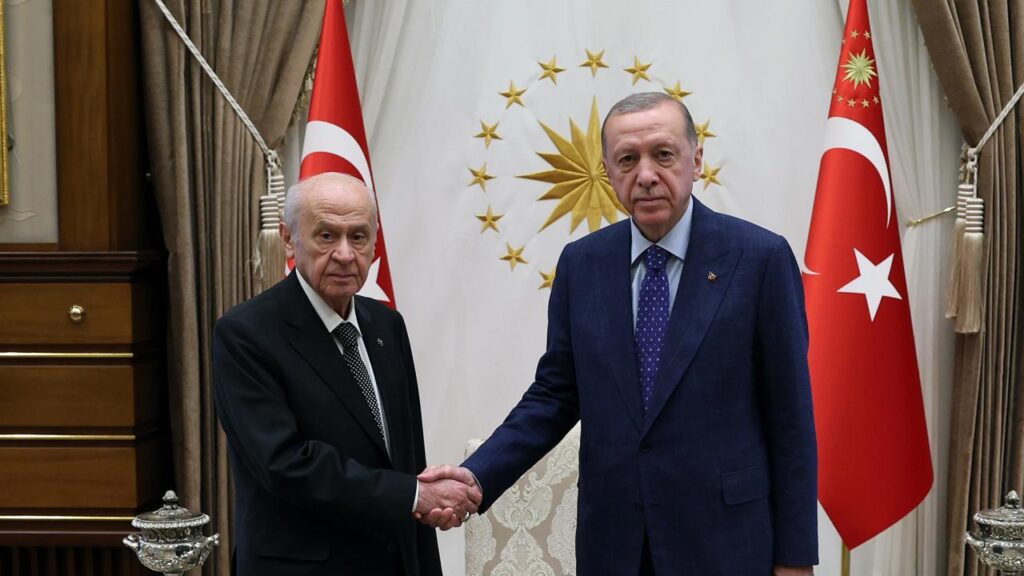
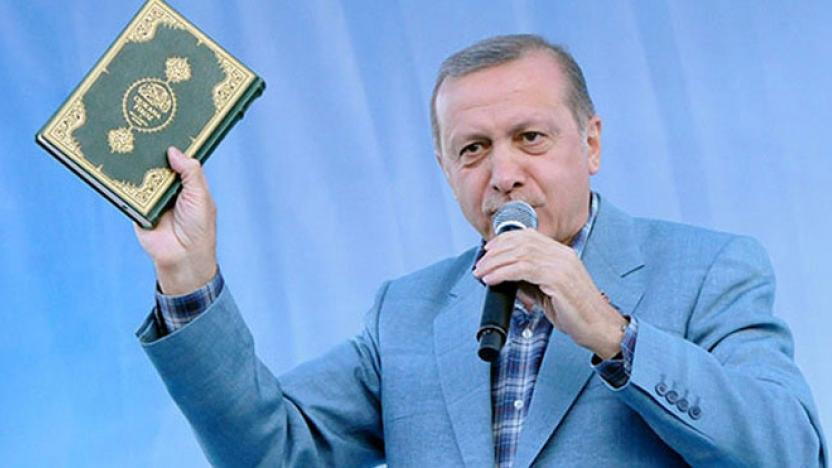
The debate over the electoral threshold is not new. On November 18, 2023, Erdogan said the requirement that a presidential candidate receive more than half of all valid votes should be changed. He argued that electing the candidate with the most votes would make presidential elections faster and avoid what he described as political maneuvering forced by the 50 percent requirement.
Bahçeli rejected that argument at the time. Three days later, on November 21, 2023, he said the 50 percent-plus-one rule was the democratic legitimacy of the presidential system and argued that the president represented the entire electorate rather than a particular constituency. MHP documents have similarly described 50 percent-plus-one as the foundation of the system’s democratic legitimacy.
Erdogan and Bahçeli, who disagreed publicly over the issue in 2023, appear to be moving toward the same broader objective, reshaping the electoral rules as the opposition becomes more divided. The Turkish Parliament can alter the electoral system with a simple majority vote, though any amendments only become effective after one year.
The potential advantage for the ruling bloc is straightforward. The opposition is no longer organized around a single presidential candidate or a single political alliance. A possible election could feature candidates from Özgür Özel’s New Party, the Republican People’s Party (CHP), conservative parties, the nationalist İYİ Party and the pro-Kurdish DEM Party. If several candidates compete separately, opposition votes could be divided among them, while Erdogan’s supporters remain concentrated behind one candidate.
The arithmetic illustrates the potential effect. In a hypothetical first-round scenario, the ruling bloc fields a single candidate who receives 39 percent of the vote, while four opposition candidates receive 38 percent, 11 percent, 9 percent and 3 percent, respectively. The opposition candidates collectively receive 61 percent of the vote, but under a first-past-the-post system, the ruling bloc’s candidate would win with just 39 percent. Under the current constitutional system, no candidate would win in that scenario because the constitution requires a majority of valid votes. The two leading candidates would proceed to a second round.
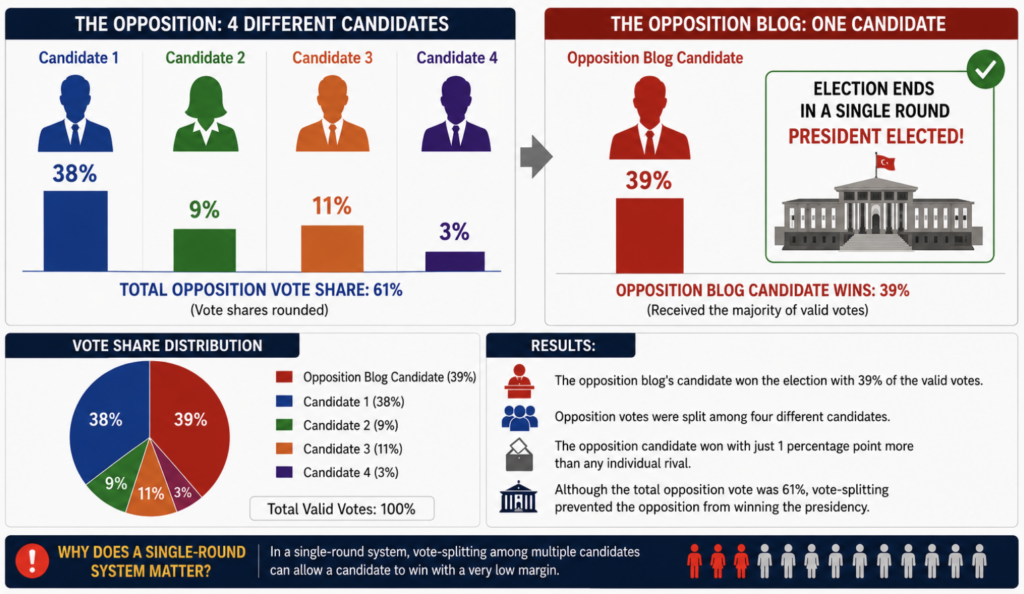
That distinction is at the center of the political argument. A single-round plurality system rewards the largest organized bloc even when a majority of voters collectively supported other candidates. A two-round system forces the leading candidates to compete for voters whose preferred candidates were eliminated.
Turkey experienced the practical importance of that rule in 2023. Erdogan received 49.52 percent in the first round on May 14, while opposition leader Kemal Kılıçdaroglu received 44.88 percent. Nationalist candidate Sinan Ogan received 5.17 percent. Because nobody obtained a majority, Erdogan and Kılıçdaroglu faced each other again on May 28. Erdogan won the runoff with 52.18 percent against Kılıçdaroglu’s 47.82 percent.
The political landscape is now considerably different. Erdogan’s most serious potential rival, Istanbul Mayor Ekrem İmamoglu, was detained on corruption accusations in March 2025 and has been jailed pending trial since then. Istanbul University annulled his university diploma on March 18, 2025, citing irregularities in his transfer to the university’s management faculty. A university degree is a constitutional requirement for the presidency, making the decision a direct obstacle to his candidacy. İmamoglu has denied the allegations and described the decision as unlawful.
The opposition has subsequently fractured further. On May 21, 2026, an appeals court annulled the CHP’s 2023 congress, removed Özgür Özel from party leadership and reinstated former chairman Kemal Kılıçdaroglu. Critics called the ruling politically motivated. Özel and 90 other lawmakers subsequently left the CHP and established the New Party, which became a second largest parliamentary party in July 2026. The split left Kılıçdaroglu heading the diminished CHP while Özel took control of the new political organization.
That fragmentation is already visible in polling. A MetroPOLL survey conducted July 18-23 on 1,236 people in 28 provinces found the New Party at 30.3 percent and the AKP at 22.4 percent in a scenario in which Kılıçdaroglu led the CHP and Özel led a separate party. The CHP came in at 2.9 percent. The DEM Party was at 5.4 percent, the İYİ Party at 3.9 percent and the MHP at 3.6 percent. The survey was conducted while the New Party was being established, and MetroPOLL said undecided voters were not distributed among the parties.

The presidential race could be even more fragmented. Özel is one possible opposition candidate. Ankara Mayor Mansur Yavaş, who currently sides with Özel, is another potential contender, and İYİ Party support for him has been discussed. The CHP could field its own candidate under Kılıçdaroglu’s leadership. Conservative parties including the Felicity Party (SP) , DEVA Party and New Welfare Party (YRP) could seek a joint candidate, with former economy minister Ali Babacan among the names discussed. Smaller nationalist parties could also nominate candidates, while the DEM Party is expected to decide whether to run separately.
The Kurdish question adds another layer. Bahçeli surprised Turkey in October 2024 by calling for Abdullah Öcalan, the founder of the outlawed Kurdistan Workers’ Party (PKK) who has been imprisoned since 1999, to address parliament if the organization ended its armed campaign. The initiative subsequently developed into negotiations involving the government and the DEM Party. The DEM Party, which represents the biggest Kurdish political movement in Turkey, has maintained close political ties with the PKK while denying that it serves as the organization’s political wing.
Those negotiations have now produced legislation. Parliament approved a framework law on August 11 providing for the suspension of investigations, prosecutions and execution of sentences after authorities verify that the PKK has ended its organizational existence and surrendered its weapons. Erdogan signed the law August 1. The measure is conditional and excludes senior figures including Öcalan.
The political consequences are harder to measure. The DEM Party’s cooperation with the government on the peace process could make it less likely to join an opposition presidential coalition. For Erdogan’s bloc, a separate DEM candidate could also prevent some voters dissatisfied with the government from transferring their votes to a single opposition candidate. There is no public evidence that this is the government’s objective, but the electoral effect would be clear if opposition candidates compete separately.
The opposition’s organizational weakness matters because dissatisfaction with Erdogan’s government remains substantial. Turkey’s annual consumer inflation was 31.75 percent in July, according to official data, with food prices up 37.53 percent and housing, water, electricity and other fuels up 40.32 percent from a year earlier.
Yet economic dissatisfaction does not automatically translate into a unified presidential challenge. That is the strategic problem facing the opposition. Unlike in Hungary, where the opposition has at times attempted to consolidate behind a single challenger, Turkey’s opposition is being pulled apart by competing parties, ideological differences, legal pressure and leadership disputes.
An election economy could become another part of the strategy as the vote approaches. The government is likely to face pressure to increase pensions and public-sector wages, support small businesses and loosen credit conditions before an election. Such measures could improve household purchasing power in the short term but would have to be balanced against the government’s stated disinflation program.
The emerging political calculation is therefore less about whether Erdogan can win a majority of Turkish voters in a direct contest than whether his opponents can prevent their votes from being divided. A unified opposition facing a single ruling candidate would force Erdogan to seek majority support. A fragmented opposition competing under a first-past-the-post system could allow the ruling bloc to win before those voters ever have the opportunity to unite behind one alternative.
That is why Bahçeli’s latest call for electoral reform carries greater political weight than a technical debate over election law. The rules governing how votes are converted into victory could determine whether Turkey’s next presidential election produces a second choice between two candidates or a president elected in a single round with a minority of the vote.